Showing posts with label Art. Show all posts

December 3, 2014

Touring Italy: Tree Cathedral

 Photos above and below by Perangelo Zavatarelli
If you are touring Italy you shall put this amazing place on your travel itinerary. This piece of art resembles a skeleton of a cathedral, built exactly in the shape, proportions and dimensions  of a gothic cathedral. Named Cattedrale Vegetale, created by artist Giuliano Mauri.


More than 600 chestnut and hazel branches around 1,800 fir tree poles are forming 42 columns, each one in diameter of 1 m and 12 metres high. These are current scaffolding, because inside of each column there is a hornbeam planted. As the hornbeam will grow the scaffolding will rot away, so one day there with lots of pruning, forming and  other effort  there will be living plant cathedral.


Photo above and all photos below by Allesandro

The scaffolding was completed in 2010 as part of the United Nations’ International Year of Biodiversity, but it will take decades to fully mature, so the 650sqmetre cathedral for decades stays evolving structure.


Don’t you think it’s worth to see it while touring Italy? Located near Bergamo close to Mount Arera.


Recommended further reading DK Eyewitness Travel Guide: Italy

March 17, 2014

Bird Houses - Spontaneous City

Looking at this art installation it all seems to be so organic and obvious. Like it’s always has been there and should stay there. Beautiful and practical at the same time. Promotes biodiversity and gives pleasure to look at. 


Made of several hundred bespoke bird house mounted on a tree, in style with surrounding architecture.


London Fieldworks' Spontaneous City in the Tree of Heaven is a project in London commissioned for the Toyal Borough of Kensington and Chelsea and Islington Council as part of Secret Garden Project – a program of events for lesser known green urban nooks of London.


As London Fieldworks says about themselves: “…interdisciplinary arts practice formed in 2000 by artists Bruce Gilchrist and Jo Joelson for creative research and collaboration at the art, science and technology intersection.”


More on London Fieldworks

***************************
If you would like to improve your garden to a beautiful paradise, let me help you to design it. We can work online. Contact me at ewamariasz [at] gmail [dot] com.

Happy Gardening!

Xoxo,
Ewa

February 6, 2014

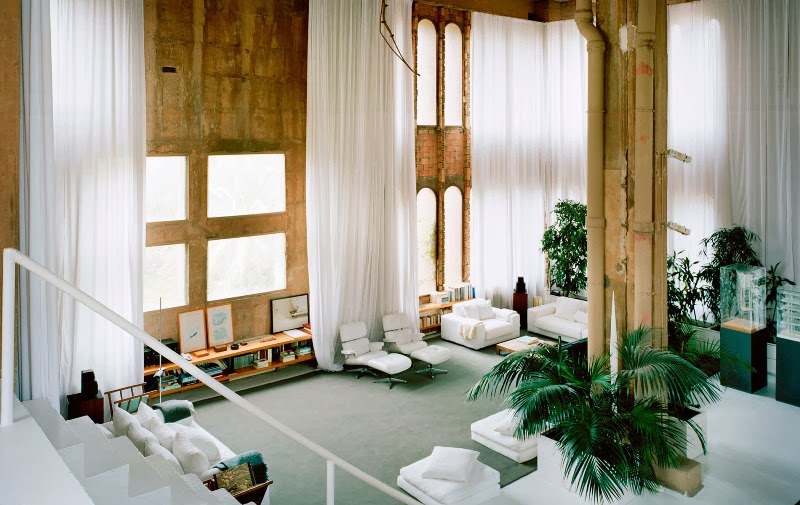
47 Photos of the Most Awesome Adaptation of Old Factory into Living Space

When I saw this awesome adaptation I got speechless. You know already, I wouldn’t take you for a time wasting  journey. So make sure you have something to drink in your mug, get more comfortable on your seat, give me your hand and let’s go and let’s spend few minutes with Ricardo Bofill the modern Spanish architect. 


What you need to know about the project - this is the renovation of 19th century cement factory in Barcelona (Spain), from demolished factory into lush personal residence, working and exhibition space.   


What’s most interesting to us, garden freaks, is the fab idea how to combine greenery with fantastic various architectural languages (Catalan civic gothic style, surrealist elements and early European post modernism), because even more stunning than the inside is the immense and beautiful gardens surround the entire area.

Just have a look how green roofs, terraces and trailing plants are complementing the amazing space created by mysterious mind of Ricardo Bofill. This is always mysterious how somebody can see the potential in falling apart, demolished concrete, right? 


The renovation began in 1973, the total floor area is over 3,100 square meters, the original industrial complex included over 30 silos, huge machine rooms and underground structures.


Just have a look by yourself, but keep my hand, cos we are not done yet, okay?


First planting appears. 


Ricardo Bofill said: “To be an architect means to understand space, to understand space organized by man, to decipher the spontaneous movements and behavior of people, and to detect the needs of change that they might unconsciously express. It is essential to track down these issues if we want to contribute with our personal work to the history of architecture.”

Thank you for the journey! 


Recommended further reading The Story of Buildings: From the Pyramids to the Sydney Opera House and Beyond
KEEP READING - MORE GREAT STUFF IN OLDER POSTS